

Republic of Guinea
The Guinean Single Window for Foreign Trade (GUCEG) held the GUCEG Impact 360 ceremony on Friday, June 26, 2026. The strategic event marked the platform's seven years of operation, reviewed its achievements, and explored its future prospects within the framework of the Simandou 2040 programme.
Held under the theme of the digital transformation of foreign trade, the ceremony brought together members of the government, the private sector, notably represented by CGE-GUI, technical and financial partners, and all stakeholders across the logistics, port, and Customs value chain. All shared a common vision: to make digital technology a central driver of competitiveness, transparency, and economic performance.
At the heart of this transformation, the Port Community System (PCS) occupies a strategic position. According to Mamoudou Diané, it is a key driver of port competitiveness.
"One of the major achievements remains the full deployment of the Port Community System, which today constitutes an essential strategic lever for the competitiveness of Guinea's port sector. However, one major challenge remains: coordinating the reduction of delays and operational bottlenecks across the entire foreign trade chain. This ceremony is the ideal opportunity to raise awareness among all stakeholders, port authorities, freight forwarders, cargo handlers, shipping agents, Customs, and sectoral administrations, of the imperative for the full adoption of the PCS in this critical area."
The Director General also placed this transformation within a broader national perspective.
"At a time when the Simandou 2040 programme is opening a new phase of economic development for our country, GUCEG is called upon to evolve further and become a strategic digital infrastructure serving trade, logistics, investment, and national economic management. This is precisely the ambition of GUCEG Impact 360: to share the achievements, identify the challenges, and build together the next stage of this transformation."
He also emphasized the collective nature of the reform.
"We have come a very, very long way (...). Public and private stakeholders have mobilized and spared no effort to establish and effectively implement GUCEG. Once again, thank you. This has been a collective movement, and it will continue to be a collective movement. GUCEG cannot claim the credit for this achievement alone. It is the result of a collective effort, and everyone has played their part. That is what makes GUCEG unique."
Speaking on behalf of the private sector, Alexandre Camara, representative of CGE-GUI, praised the efforts undertaken while calling for an acceleration of structural reforms.
"The economic transformation of our country can only be achieved through strong, structured, and permanent collaboration between the State and the private sector. Our country is entering a new phase of its economic history with the ambition embodied in the Simandou 2040 vision. This ambition requires competitive companies capable of investing, producing, exporting, and creating sustainable employment."
He stressed the need for a more predictable business environment.
"Businesses need an environment of trust. They need even simpler procedures, an efficient administration, clear and predictable rules, as well as a partnership with the State based on dialogue and responsibility. It is in this context that we appreciate the efforts undertaken to modernize foreign trade through GUCEG. The digitalization of procedures, the reduction of processing times, and administrative simplification are significant advances in improving the competitiveness of our economy. In a globalized world, administrative speed and efficiency have become major factors of attractiveness."
On the issue of public-private dialogue, he welcomed the mechanisms that have been put in place.
"We welcome the establishment of the consultation framework between public administrations and economic operators. This permanent framework for dialogue must enable us to identify constraints, resolve operational challenges, and build appropriate solutions together. We also encourage the momentum established between the tax administration and the private sector, because taxation must be based on transparency, predictability, fairness, and dialogue."
He broadened the discussion to investment security and institutional reliability.
"An investor does not come only for tax exemptions. An investor comes first and foremost for the security of their investment. We must strengthen the capacity of the Commercial Court. We must also strengthen our archiving policy. GUCEG forms part of our country's archiving policy. Documents must be authenticated, accessible, and reliable in order to reassure investors. Even today, the interconnection between Customs and the Tax Administration must be fully effective. Citizens must understand that the Tax Administration, Customs, GUCEG, and the private sector all pursue the same objective. A country can only develop through transparency. A country can only develop through everyone's efforts. Together, we will succeed in developing our country."
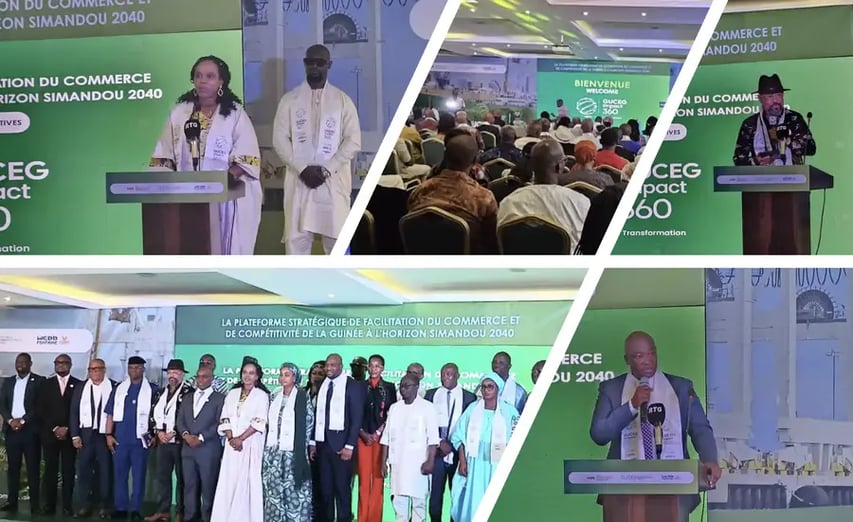
Officially opening the event, the Minister of Economy, Finance and Budget, Mariama Ciré Sylla, placed GUCEG within the broader trajectory of the State's economic transformation.
"In 2024, Guinea recorded a growth rate of 6.1%, twice the average for Sub-Saharan Africa. Exports increased by 39.5%. Behind every export, every container processed, and every procedure secured through digital technology, these figures tell the story of a country that is moving forward, implementing reforms, and delivering results. This ceremony is not merely a celebration. It is a moment for assessment and decision-making, to measure what GUCEG has made possible and to decide together what still needs to be achieved."
She also gave a positive assessment of the Single Window.
"In seven years of operation, GUCEG has demonstrated that the Guinean State is capable of reforming, honoring its commitments, and delivering tangible results. Today, the platform connects commercial banks, the Central Bank, Customs, port authorities, land border posts, and economic operators throughout the country. For economic operators, this means less time lost, lower costs, greater clarity, and more confidence in their interactions with the State. For the State, it means better secured revenues, improved monitoring of trade flows, and reliable data to guide economic policy."
Simandou 2040 as a strategic horizon
Looking ahead to Simandou 2040, the Minister outlined clear operational priorities.
"Two initiatives must be accelerated: the full adoption of the Port Community System by the entire port community and the launch of the Transport Insurance Certificate. These are government priorities, and we expect visible progress on both this year. Guinea has the resources and is putting the platforms in place. What will make the difference is the collective determination to use them to their full potential, without delay."
She also delivered a direct message to public administrations.
"Connecting to GUCEG is no longer an option. Service agreements with GUCEG must be finalized by all the administrations concerned. To the port and logistics community, the Port Community System is operational; its deployment across mining ports, inland platforms, and transport corridors is essential. To economic operators, this platform also belongs to you. Your experiences, your suggestions, and your needs matter."
Addressing the issue of digital archiving, she responded to the concerns expressed by the private sector.
"I have heard Mr. Camara's request. I am pleased to tell you that we are already working on it. We will begin this partnership in July."
She concluded by summarizing the strategic importance of GUCEG.
"Today, GUCEG embodies the ability to transform the country's wealth into revenue for the State, trade into jobs and services for citizens, and the reforms undertaken into visible and lasting benefits. The challenges ahead are significant. They require digital infrastructure that is fit for purpose, sustained political commitment, and the collective engagement of all stakeholders. It is with this conviction and this shared responsibility that I officially declare the GUCEG Impact 360 ceremony open."
The ceremony continued with two thematic panel discussions dedicated to GUCEG's future within the Simandou 2040 framework and its contribution to port competitiveness. Roundtable discussions then enabled the various stakeholders to share their experiences and propose concrete ways to accelerate the digital transformation of Guinea's foreign trade.
Through GUCEG Impact 360, Guinea has reaffirmed its ambition to make digital technology not only a tool for administrative modernization, but above all a fundamental pillar of its economic competitiveness by 2040.
Published on Guinee360.com on June 26, 2026.
Useful resources
🔗 Digital addict: Leading the digital revolution in Africa
About Webb Fontaine
Established in 2002 and headquartered in Dubai, UAE, Webb Fontaine is a leading technology company specialising in Artificial Intelligence-driven solutions for global trade. With offices spanning Europe, the Middle East, Asia, and Africa, the company leverages its extensive expertise to provide governments and communities with innovative solutions that streamline trade processes and enhance efficiency.
Webb Fontaine is renowned for its pioneering technologies that help reduce trade fraud, improve Customs revenue, and expedite clearance times, supporting smoother and more profitable trading ecosystems. The company prides itself on a diverse workforce of over 700 professionals from 41 nationalities, emphasising a culture of excellence, innovation, and integrity.
The firm’s commitment to research and development is unmatched, owning the largest R&D centres in the trade sector, which are pivotal in advancing trade technology and practices. Webb Fontaine’s accolades include numerous international awards and certifications, underscoring its dedication to quality and leadership in trade facilitation.